GLP‑1 Weight Loss Drugs Explained (Wegovy, Ozempic, Mounjaro) — and what to track in Healthcount
Written by Anna Bromley, Healthcount Founder · Last reviewed: December 2025
If you've been hearing about GLP‑1 weight loss drugs (sometimes called "weight loss injections"), you're not alone. People talk about Wegovy, Ozempic, and Mounjaro everywhere — on TikTok, at work, in group chats, and in GP waiting rooms.
But once you get past the hype, most people still have the same questions:
- What are these drugs actually?
- Do they work the same way?
- Who can get them in the UK?
- And how do you track progress without making it your whole personality?
That last bit is exactly where Healthcount helps — you can track food, exercise (active calories), measurements, progress photos, and dosing in one place, so you're not juggling notes apps and half-finished spreadsheets.
Quick safety note: these are prescription medicines. This article is for general education, not medical advice. If you're taking one already, or thinking about it, speak with a qualified clinician who knows your history.
Quick answers
- GLP‑1 weight loss drugs are prescription medicines that can support weight loss by helping you feel fuller and changing appetite signals.
- In the UK, weight management injections like semaglutide (Wegovy), tirzepatide (Mounjaro), and liraglutide (Saxenda) are taken as injections and must be prescribed by a healthcare professional as part of a supported programme.
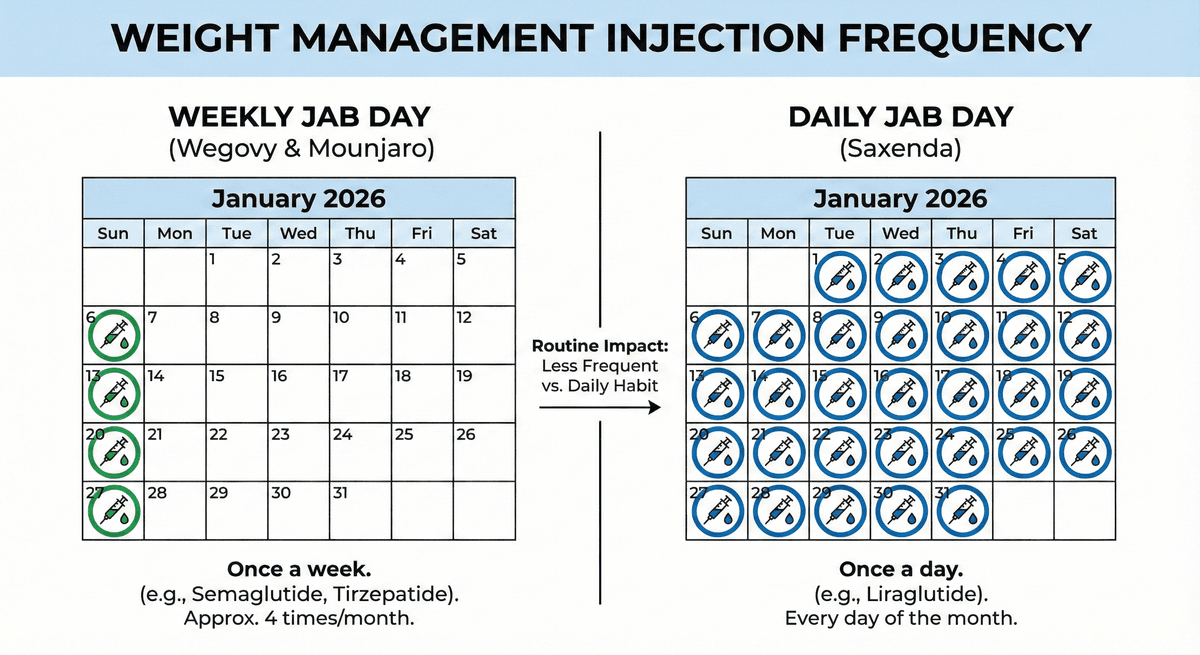
- Wegovy (semaglutide) is taken once a week and is prescribed via a specialist weight management service.
- Mounjaro (tirzepatide) is also taken once a week and may be available via specialist services, and (for some people) via GPs if eligibility criteria are met — but access is phased and varies locally.
- Tracking doesn't need to be perfect. If you only manage dose + weight once a week, that's still a strong start (and you can build from there).
What are GLP‑1 weight loss drugs?
GLP‑1 weight loss drugs are medicines designed to help with weight management (and often blood sugar control too).
You'll hear people say "GLP‑1" like it's one drug. It's not. It's more like a family of medicines that work on similar signals in the body.
In the UK, the NHS lists these as weight management medicines used alongside lifestyle support, and includes injections such as:
- liraglutide
- semaglutide
- tirzepatide
Glossary
| Term | What it means |
|---|---|
| GLP‑1 | A natural hormone signal linked to appetite and blood sugar control |
| Injection pen | A pre-filled device used to inject a set dose under the skin |
| Dose | The amount of medicine you take each time |
| Titration | Slowly stepping up the dose over weeks to help your body adjust |
Wegovy vs Ozempic vs Mounjaro: what's the difference?
Let's stop the confusion right here: brand names and drug names get mixed up constantly.
Here's the clean version:
| Name people say | What it usually refers to | What it's mainly used for |
|---|---|---|
| Wegovy | semaglutide (weekly injection) | Weight management |
| Ozempic | semaglutide (weekly injection, different licensing/packaging) | Type 2 diabetes (weight loss can happen, but it's not the same product as Wegovy in UK weight management pathways) |
| Mounjaro | tirzepatide (weekly injection) | Type 2 diabetes and weight management pathways (eligibility rules apply) |
| Saxenda | liraglutide (daily injection) | Weight management |
If you're ever unsure: look for the compound name (semaglutide, tirzepatide, liraglutide) — that tells you what the medicine actually is.
How do GLP‑1 weight loss injections work?
Here's the simplest explanation that's still true:
These medicines can help reduce appetite by:
- making you feel fuller
- slowing down how quickly food leaves your stomach
That's why people often say things like:
- "I get full faster"
- "I don't think about snacks as much"
- "I stopped picking at food without noticing"
And that's also why tracking helps — because the changes can be subtle at first, and your brain loves to forget progress if you don't record it.
How often do you take them?
Frequency matters because it affects routine (and routine is what makes adherence realistic).
| Medicine (UK weight management injections) | How often it's taken |
|---|---|
| Semaglutide (Wegovy) | Once a week |
| Tirzepatide (Mounjaro) | Once a week |
| Liraglutide (Saxenda) | Once a day |
Who can get GLP‑1 weight loss injections in the UK?
This is where things get real, because demand is huge and access is not the same everywhere.
Wegovy (semaglutide) in England
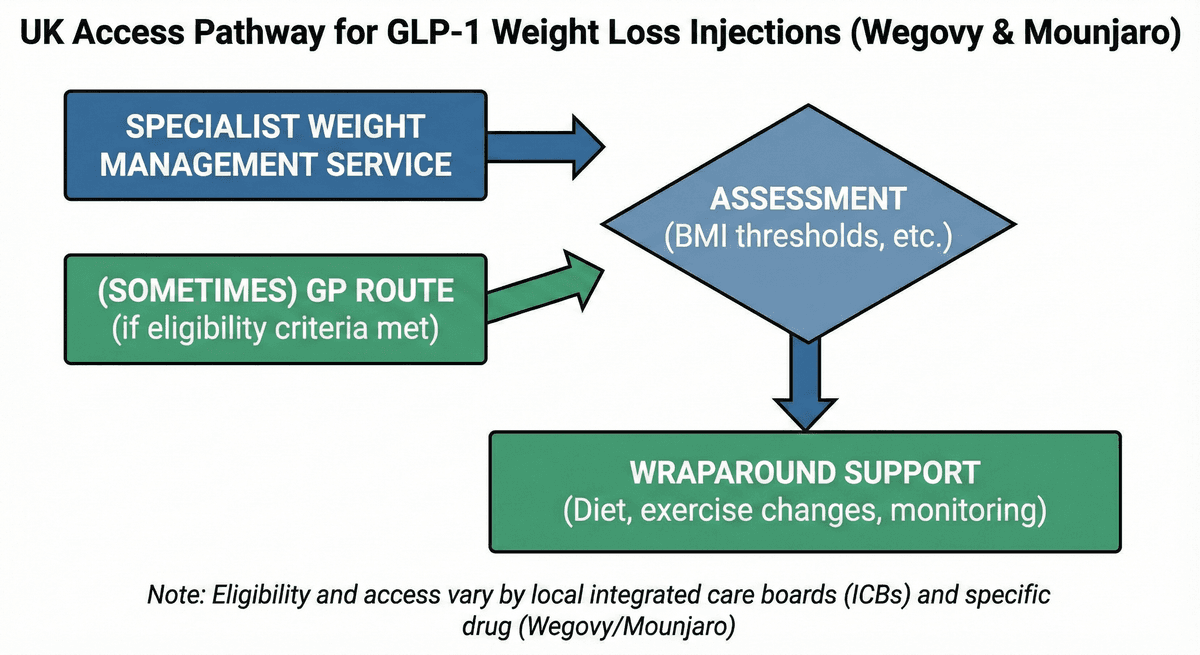
NHS England explains that you can only take semaglutide (Wegovy) if it's prescribed by a specialist weight management service, and it's typically considered when diet and exercise changes haven't worked on their own.
NHS England also lists BMI thresholds and notes that eligibility can vary by local integrated care boards (ICBs).
Mounjaro (tirzepatide) in England
NHS England says that, from March 2025, tirzepatide for weight management may be prescribed via specialist weight management services, with a phased approach in primary care and initial focus on people with the highest clinical need.
The NHS also describes eligibility rules for GP access (for some people) based on BMI and multiple weight-related conditions.
Why private prices can feel wildly higher than NHS prices
If you've ever thought, "Hang on… why does the NHS talk about these medicines like one thing, but the private clinic charges me something totally different?" — you're not imagining it.
A few reasons often stack together:
- Private pricing usually includes services, not just the medication
Think: assessments, follow-ups, prescribing, delivery, reminders, admin. - Supply and demand matter
When demand is intense, the private market can price in sourcing risk and stock continuity. - NHS access is tied to pathways
The NHS focuses on structured programmes with wraparound support, and eligibility often routes through specialist services.
If you want a practical takeaway: compare like-for-like.
- "Medication only" cost (same dose, same month)
- plus any clinic fees
Common side effects
Most people don't stop because a drug "doesn't work". They stop because side effects make it miserable.
The NHS describes that before prescribing weight management injections, clinicians will talk through benefits and limitations, including possible side effects.
Common ones people report include stomach-related symptoms (because these medicines slow digestion). Here's a simple, non-scary guide:
| What you might notice | What often helps |
|---|---|
| Feeling sick / nausea | Smaller meals, slower eating, avoid greasy foods for a bit |
| Constipation | More fluids, add fibre slowly, gentle movement |
| Reflux / heartburn | Smaller portions, avoid late meals |
| Feeling "too full" | Don't force big meals — split into smaller ones |
Also: the NHS notes weight management injections slow stomach emptying, which matters if you're due to have surgery or sedation — it's something you should tell your healthcare team about.
What to track in Healthcount (minimum effective tracking)
This is the part that makes the whole journey calmer.
Because if you don't track anything, your brain will do this:
- You'll have a "stall week" and assume nothing is happening.
- You'll forget the good weeks.
- You'll start changing everything at once (and then burn out).
The rule: don't let perfect be the enemy of good
The NHS literally encourages people to start small and build up gradually — and that mindset works brilliantly for tracking too.
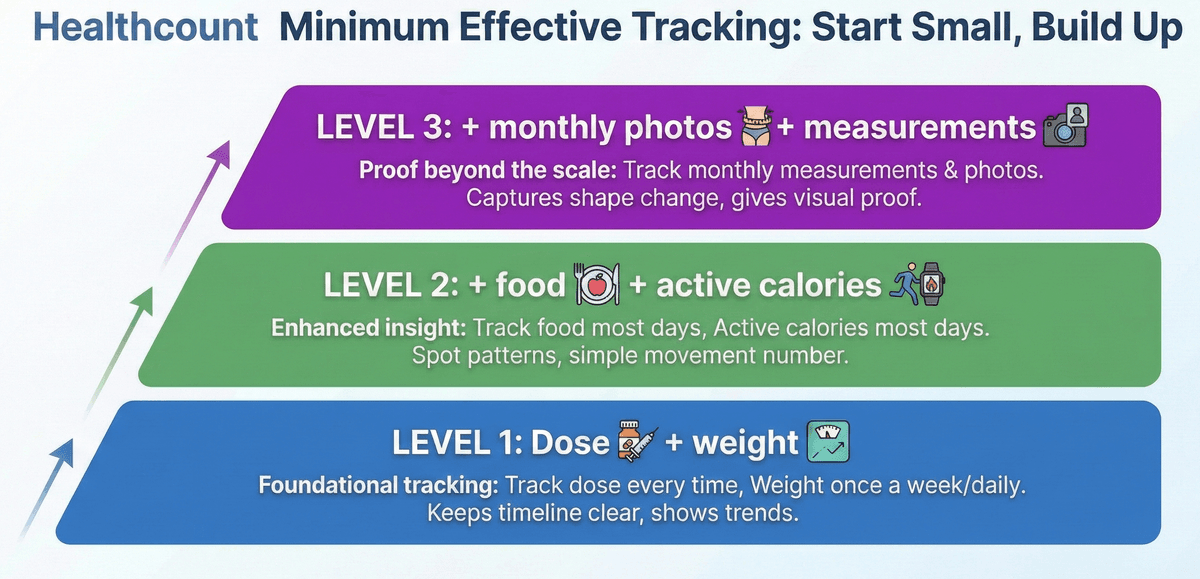
So here's your minimum effective tracking, designed for real life:
Level 1: "I'm busy, but I want to start"
| Track this | How often | Why it's worth it |
|---|---|---|
| Dose | Every time you take it | Keeps your timeline clear (and stops "Did I take it?" panic) |
| Weight | Once a week (or daily if you prefer) | Shows trends over time, even when day-to-day jumps around |
Level 2: "I want better insight without obsessing"
| Track this | How often | Why it's worth it |
|---|---|---|
| Food | Most days (even if it's rough) | Helps you spot patterns (not perfection) |
| Active calories | Most days | Gives you one simple movement number you can actually stick with |
Active calories = the energy you burn through movement/exercise (often shown in wearables and fitness apps). It's not "steps", it's just a clearer "how active was I?" number.
Level 3: "I want proof, even when the scale lies"
| Track this | How often | Why it's worth it |
|---|---|---|
| Body measurements | Monthly | Captures shape change even in scale stalls |
| Progress photos | Monthly | Gives visual proof you can't argue with |
Two articles that will save you time
If you're using Mounjaro, these two posts are perfect "next clicks" because they answer the exact questions people get stuck on mid-treatment:
- How Much Mounjaro Is Left in My Body After 1–7 Days? (Great if you're wondering why appetite feels different on different days of the week.)
- Mounjaro UK conversion to mL and units (Great if pen dosing and units are confusing — especially when people discuss doses differently online.)
Track your weight loss journey in Healthcount
Get StartedFAQs
1) What are GLP‑1 weight loss drugs?
They're prescription medicines that support weight loss by reducing appetite and slowing stomach emptying, and they're used alongside diet and activity support.
2) What's the difference between Wegovy and Ozempic?
They're both forms of semaglutide, but they're licensed and used differently (Wegovy is the weight management brand; Ozempic is mainly for type 2 diabetes).
3) Is Mounjaro a GLP‑1 drug?
Mounjaro (tirzepatide) works on GLP‑1-related pathways, but it's often described as a dual-acting medicine rather than "GLP‑1 only".
4) How often do you take Wegovy or Mounjaro?
Wegovy and Mounjaro are typically taken once a week; Saxenda is taken once a day.
5) How do I get GLP‑1 weight loss injections in the UK?
In England, NHS England says Wegovy is prescribed through specialist weight management services, and access can vary locally, so you check eligibility via your local NHS pathway/ICB.
6) Why does my weight go up and down even if I'm "doing it right"?
Daily weight changes happen because of water, salt, sleep, stress, and digestion. That's why weekly trends (or daily weights viewed as a trend) matter more than one reading.
7) How often should I weigh myself on a GLP‑1?
Anywhere from once a week to daily works — pick the option that keeps you consistent without stressing you out.
8) What should I track while taking Wegovy or Mounjaro?
Minimum effective tracking is: dose + weight. If you can do more, add food and active calories, then add monthly photos and measurements for proof beyond the scale.
9) Why do private clinics cost more than what I read online?
Private prices often include the medication plus prescribing, follow-ups, delivery, and clinic support — so it's not always a straight "drug-only" comparison.
10) Do I need to track everything to succeed?
No. Start where you are. If you only track dose and weight for the first month, that's still a big win — and you can build from there.
11) Are GLP‑1 weight loss injections safe for everyone?
No. They're not suitable for everyone, and the NHS notes they aren't recommended in pregnancy and may not be suitable with certain health conditions — a clinician should check your personal situation.
12) What's the easiest way to stay consistent on these medicines?
Make the routine smaller: pick one weekly weigh-in day, log every dose, and do a monthly measurement/photo check-in. The smaller the habit, the more likely you'll stick to it.
Sources
NHS obesity treatment guidance
Comprehensive NHS guidance on weight management options
NHS England weight management injections
Official guidance on Wegovy and Mounjaro access pathways
Start tracking your GLP‑1 journey today
Get Started